Who We Are
Stockton Heath Methodist Church is part of the Methodist Church of Great Britain and Ireland.
- We exist to worship God in Jesus
- We desire to have a relationship through God’s love
- We believe in evangelism and leading people to faith
- We offer our service which is working out God’s love in the Methodist Circuit and the community around us
- We believe in fellowship and building each other up
We are a local committee, representing Christian churches in the Appleton, Daresbury, Grappenhall, Stockton Heath, Stretton and Walton areas.
We organise joint services of worship – at Easter, Pentecost and Christmas ,Christian unity in January and the annual Stockton Heath Walking Day in July. Collections from services are given to charities locally and overseas.
BCT has been involved with Broomfields Youth Project since 2008 ( formerly The Youth Bus ). The project meets on Fridays from 7.30pm – 9.30pm ,over two sites . There is organised football on the all weather pitches at Broomfields Leisure Centre, and a cafe + Christian fellowship held at St. Mary Magdalene’s Church Hall,on Bridge Lane, Appleton.
Individual Methodist Churches are part of larger groups called CIRCUITS which in turn are part of even larger groups called DISTRICTS.
All the Districts in England, Scotland and Wales form the Methodist Church of Great Britain. This is known as the CONNEXION to remind individual members and local churches of their interconnected and interdependent nature. Ireland (both the Republic and Northern Ireland) is a separate Connexion.
STOCKTON HEATH METHODIST CHURCH is in the SANKEY VALLEY CIRCUIT which is made up of 24 churches. :
Antrobus Methodist Church
Ashton (Queen’s Road) Methodist Church
Bold Street Methodist Mission (Warrington Mission)
Burtonwood Methodist Church
Cronton Methodist Church
Cross Lane United (Newton)
Farnworth Methodist Church
Heath Street (Methodist Church in Golborne & Lowton)
Hood Manor Methodist Church
Latchford Methodist Church
Lymm Methodist Church
New Song Network
Nutgrove Methodist Church
Padgate Methodist Church
Penketh Methodist Church
Prescot & Whiston Methodist Church
Rixton Methodist Church
St James (Rainhill) Methodist Church
St. Martin’s (Woolston) Methodist Church
St. Philip’s LEP (Westbrook)
Stockton Heath Methodist Church
Sutton Methodist Church
Trinity ( Widnes) Methodist Church
Wesley Methodist Church, St Helens (including Balmer Street)
Our ordained staff comprises eight ministers, including a deacon, and a minister attached to the Circuit with responsibility for the Warrington Borough Ministry project.
There are a number of websites that can help you with your research.
The Methodist Church website has a section on Methodist History and Genealogy. This link will take you to the Genealogy section.
The Methodist Church – Genealogy
Elizabeth DuBois’s site has sections for UK and USA research
Researching your Methodist Ancestors
Sign up for the Methodist-L@Rootsweb.com mail list that Elizabeth maintains. Send an e-mail to
methodist-l-request@rootsweb.com
Two useful books are:
My Ancestors Were Methodists by William Leary
ISBN 1-85951-403-0
Published by the Society of Genealogists
and
Mr Wesley’s Preachers by Kenneth Garlick
ISBN 901 262 18 8
Published by Pinhorns for the World Methodist Historical Society
This was a limited edition and I have a copy from which I will do look-ups if you cannot get hold of a copy personally.
The Millennium project took the next step in modernising the church building. The choir pews were removed, the rail and area round the communion table was redesigned, new carpet was laid and a new warm, pink colour scheme was used. It was “opened” on Advent Sunday 2000 to general pleasure.
The fundraising for this project marked the start of the principle we have used ever since in that 10% of all of our fundraising for projects in the church and hall buildings goes to charity. Every year we have been enabled to give substantial amounts to local, national and international charities suggested by our members in addition to the amounts given to long-standing Methodist and other Christian charities.
Since then small changes have been made to the building along with developing a PA and multi-media system to enhance our worship
We are now on a further major modernising project as described in the “Redevelopment” pages. Work has started (summer 2009) and will proceed as we have the funds available.
This has been a brief outline of the history of SHMC.
If you have more information or photos that you would like to share with us please make contact through the same email address.
The archives of the former Warrington Methodist Circuit which includes most Stockton Heath Methodist Church material are at the Cheshire Record Office, Chester.
Warrington Library: Local History Section has some documents relevant to SHMC and to the wider Circuit.
At the March 1959 Circuit Quarterly Meeting permission was given to apply at some time in the future to alter the church building to provide more seating accommodation.
The costs of the hall building project were still being paid off but at a Society meeting on 15th September 1959 it was resolved that when these debts had been paid and a further £6000 had been raised, then plans could be made for modernising the interior of the church. To start this further fund-raising a Gift Day was held. There was another one the following year which was posted as being the major effort for the year.
It wasn’t until the March 1962 Circuit Quarterly Meeting that an application for authority to undertake the extensions at a cost of £11500 was submitted and unanimously approved. £6000 was already in hand, £1250 was hoped to be raised leaving £4250 to be borrowed from the Chapel Aid Association.
The building work was carried out in 1964 at a cost of £17000. The last service was held on 5 April 1964 and exactly seven months later on 5 December on a cold, wet, foggy Saturday afternoon the renovated interior was opened by Mrs Polly Cliffe, one of the oldest church members and a member of the choir. The next day services of thanksgiving were conducted by the Church’s own minister Rev DF Vickers & the Circuit Supt Rev S Brown.
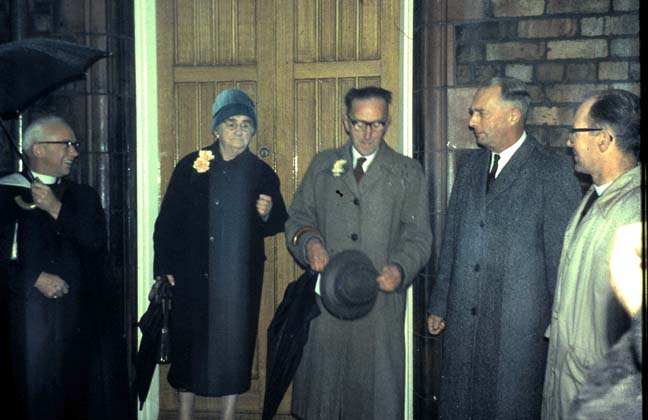
(Left to right) Revd S Brown, Mrs Polly Cliffe, Mr J H Williams, Mr Jack Ashall, Revd Don Vickers,
Thanks to Revd John Bland who has emailed to advise that the gentleman in the centre is Mr J H Williams, who was church treasurer for many years and lived in Greenway, off Dingleway.
Photo: Malcolm Spencer

Church interior, 1964, before the cross was added at the front
Continued – “Modernisation – Take 2”
(c) Kit Heald
By the 1920s Stockton Heath was beginning to become a more desirable place to live.
In March 1923 the site of the present Church Hall was bought: this was some land plus 11 cottages 55-75 Walton Road at a cost of £1300. The total outlay including ground rent was £1908 with the outstanding debt being £1863. The cottages now (2009)still to be seen opposite the church had been built in the 1830s when the road was first turnpiked and so are known as Toll Bar Row. Some others which were demolished in order to build the hall were called Duke’s Cottages and had been erected to house workers on the Bridgewater Canal. Since the hall has been built all the remaining cottages have been sold, the last one in 2000.
The debt of £1863 was paid off in 1932 and in July 1935 the Trustees recommended building a new church seating 500 on that site and remodelling the present church as the Sunday school. This would have cost £7000 and an Extension Fund Committee was set up as a jubilee effort (1887-1937) with the aim of completing the work by 1937. Various plans for these schemes survive and can be found in the circuit archives.
Problems with a road widening scheme and the coming of World War II temporarily stopped all building activities but as soon as licences were being given out again after the war the then Trustees realised that the Sunday School needed more room too. Indeed the Sunday school had been using two of the cottages as the tenants had moved out.
In 1949 the trustees decided to formulate plans to include the erection of a new church and ancillary accommodation on this site on the north side of Walton Road and the provision of adequate Sunday school accommodation by reconditioning the present church. A special church meeting was called.
In 1950 plans were agreed with the church fronting onto Hawthorn Road and the side onto Walton Road. However during the following year the Chapel Committee was still asking for alterations to the plans and for the next 2 years there were administrative problems with the scheme.
In October 1952 the Warrington Guardian reported that the District synod had passed plans for building a new church on the site. The scheme would be in 2 parts with firstly a church seating 400 being built then behind this a hall with a stage able to seat 300 and 2 classrooms. The organ was to be sunk in the floor like a cinema organ.
But in 1953 a new trust was set in place and the trustees decided to take another look at the whole scheme and so recalled all plans. Discussion was held on whether to proceed with the original plan or try something else; for example, Appleton was looked at as an area in which to start anew. In December the first scheme was abandoned and plans put forward to build a new Sunday school and hall on the north site and after that make alterations to the church.
The first revised set of plans submitted to the Chapel committee in 1954 were returned with a request that they be scaled down – they did not see why an upstairs was needed – and the trustees were also asked why they had not gone ahead with the first plans! At this seemingly late stage the trustees set up a sub-committee to find out who would use the new premises and what the minimum requirements of the building would be. Plans were then accepted by the trustees and the sub committee became the Building Committee. But even then it was not plain sailing as in 1955 the Chapel committee again wanted more alterations and the trustees agreed with their suggestions. Finally, or so it was thought, in March a congregational meeting agreed to go ahead with the whole scheme. In April there was a Gift Day to help with the fund raising.
In March 1955 the Warrington Guardian reported that plans were in hand to build the new hall needed because of the inadequacy of space for all the competing needs of the present schoolroom. The J Arthur Rank Foundation give £6000 and the Chapel Department £1000 but to qualify for these there had to be no more than £750 debt when the building finished.
As mentioned earlier some of the cottages were demolished and building began in December 1955. However, almost immediately a major problem was discovered: as the foundations were being dug it was found that the site was in fact an old rubbish tip and not stable enough for the plans as they stood. The extra work needed to completely remove the rubbish was going to cost over £2000. Would the church commit itself to raising this extra amount?
The question was put to an emergency meeting and it gave the go ahead. At least some good came out of this near disaster: as extra digging would be involved it was decided to put to good use the hole that would be made and it became the extra cellar that is now used for dramatic society storage.
Obviously there were many fund raising efforts – sales of work, sewing meetings, jumble sales, social evenings, beetle drives, concerts; every section of the church and individuals gave money. There was also a scheme to purchase bricks where everyone who bought a brick put their name in a book but this book seems to have disappeared; if anyone knows its whereabouts I would be interested in seeing it and placing it into the church archives. Some people gave gifts and some gave interest-free loans; the voluntary giving scheme raised over £1000. It cost £22000 to build the hall: £2700 more than expected because of the problems with the foundation.
On 24 March 1956 15 foundation stones were laid by or for:
- Rev WO Phillipson (secretary, Methodist Chapel Dept)
- Rev JH Sanders (former superintendent of the circuit on behalf of Rev & Mrs Kewley)
- Mr G Benson (on behalf of the church congregation)
- Miss V Stobbs (on behalf of the Sunday school)
- Miss Nora Withinshaw (on behalf of the Withinshaw family)
- Mr R Lunt (for Mrs Richardson)
- Mr H Harris
- Mrs P Cliffe
- Mr B Dudley
- Mr WA Bromley
- Mr L Ardern
- Mr G Gould
- Mr Wadell
- Mr G Benson jnr
- J Arthur Rank Benevolent Trust
These names can be seen on the plaque in the entrance hall. Mallets were given by Messrs Stobbs and Benson. The J Arthur Rank Foundation gave £6000 and a plaque commemorating this fact is also in the entrance hall. The Chapel department gave £1000. The architect was A Brocklehurst of Manchester.
Finally on 17 March 1957 the hall was opened by Mrs EH Wadell the wife of a previous supernumerary minister who had lived in Stockton Heath for many years. The service was due to be conducted by the chairman of the district Rev SJ Granville but he was ill so Rev J Sanders deputised with the Warrington circuit superintendent Rev JT Hughes, the minister of the church Rev J Mellor and the Sunday school superintendent Mr Cyril Roughsedge all taking part. The sermon was preached by Rev A Hearn secretary of the Chapel department. The service was followed by tea then a meeting where Mr W Pearce, treasurer of the building fund, presented his report and good wishes were conveyed by representatives of other churches. There was also a special scholars dedication service when the preachers were Rev J Mellor and the Rev CJ Thomas a previous minister of church.
Our predecessors in the church worked long and hard to provide good accommodation for the future. But, oh, how we wish they had gone ahead with the 1950 plan to build a new church and hall on one site!
Continued – “Modernisation!”
(c) Kit Heald
Towards the end of the century the 3 Free chapels in Stockton Heath and Appleton: the Wesleyan Methodists, the Independent Methodists and Hill Cliffe Baptists had formed a joint Band of Hope (Temperance organisation) which was a thriving concern and well organised. They held other joint services to break down barriers and to consolidate Free Church forces.
Membership gradually increased from 12 in 1888 to 29 in 1902 and soon the one roomed building became too small. It was reported that the church was losing many children and young people because of the lack of facilities.
The trustees tried to find land elsewhere for a bigger church but they were unsuccessful so they decided to rebuild on the same site. The last service,the Sunday School Anniversary, was on 14 March 1905. The next day a congregational tea was held paid for by Mrs Sherburn when 120 sat down and this was followed by a meeting at which Mr Richard Miller and others told the history of the society and talked about future prospects before the chapel was given over to the builders. Services were held in Providence schoolroom (Independent Methodist: now Christian Fellowship) while building work was proceeding.
Bazaars and other fund raising events in Stockton Heath and around the Circuit took place in order to raise the £1500 that was needed. Many members in the Circuit expressed sympathy with the people at Stockton Heath with the need for a bigger building and they helped the building fund on its way.
The Memorial Stone laying ceremony was on 22 June 1905 and this is how the Warrington Guardian started its report on the event:
“Great interest was taken by local Wesleyans on Thursday afternoon in the laying of the foundation stones and bricks of the new church at Stockton Heath. There was a large attendance of friends of the church and school children were much in evidence. There was only one drawback to the pleasure of the visitors and that was the intense heat. It was almost unbearable and but for the use of umbrellas and sunshades and the shelter of 2 or 3 trees in front of the site there might have been some cases of sunstroke…..”
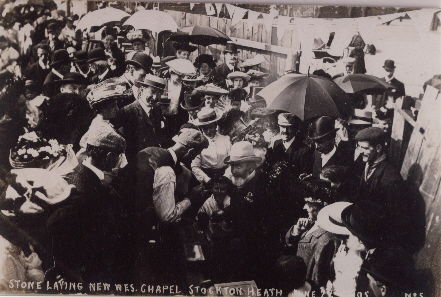
Laying the Foundation Stones: 22 June 1905
Sixteen foundation stones were laid but unfortunately it is now impossible to determine whether there was any inscription on them. They were laid by:
- Mr A H Crosfield,
- Mr J E Richardson (for Mrs Richardson),
- Mr William Bennett (for Mrs Bennett),
- Mr Joseph Stringer (for Mrs Stringer),
- Mrs Moss (for Mrs Lancashire),
- Mr T Brough (for his father),
- Mr W Arnold (who had presented the stones),
- Mrs S W Stringer,
- Mr W H Sherburn,
- Mrs F Penketh,
- Mrs A Blackhurst,
- Messrs Richard Miller,
- P J Whitfield,
- F Pendlebury,
- S Moss (for the church)
- A Lamplugh (for the local preachers)
To save money special trowels were not provided but suitably inscribed hymn books were presented to the 16 stone layers. Bricks were also laid by children who had made collections in aid of the building fund.
The Warrington Review (Stockton Heath edition) gave more details about the building:
“…..the building when completed will make an ornamental structure comprising a church 44’x34′ with a schoolroom behind about 60’x30′. In addition, there will be 3 vestries and a convenient basement in which will be set up a kitchen range and boiler, etc. The whole building will be surrounded by a boundary wall and ornamental iron railings and gates. The buildings will be faced with St Helens grey bricks and red terra cotta heads, sill and string bands and copings etc. At the corner of the building there will be an octagonal tower carried up to a good height and having louvre openings in the upper portion to be used as an extract ventilating shaft. Ornamental tracery windows will be fixed in the main gable and the transept gables glazed with cathedral tinted glass. The internal wood will be in pitchpine, stained and varnished; the building will be warmed by hot water pipes and radiators. Due attention will be paid to the ample ventilation of the school. Additional accommodation can be obtained if required by means of a gallery to be fixed over the front entrances access being gained thereto by means of staircases from the small vestries at the front of the church….”
The building was opened at 3.0 pm on 2nd November 1905 by Miss Bessie Dutton of Moore – one month later than expected ‘to allow the plaster to dry’ – and again the Warrington Guardian was there to report it:
“Thursday was a notable day…..marking as it did the handsome new church and schools in Walton Road, Stockton Heath……The church will seat about 270 and the schoolroom 300 and on Thursday the accommodation was found none too extensive to seat the large number of friends who came to see the opening….Miss Dutton said…..this new church was eloquent testimony to the love, enthusiasm and energy in the hearts of those connected with the church.”
The large congregation included massed choir and orchestra. One man is quoted as saying “This place of course is dreadfully new and has none of the associations which make old buildings so dear to us, but perhaps this day we have made what we will look back upon as a happy recollection” How right he was!
In the evening a public meeting was held in the Independent Methodist Church and the collections for the day raised £474.12s (£474.60p)
There was a partition between the church and the hall which could be removed to provide an enlarged church area for special occasions. The final cost of the buildings and furnishings was £1700.
The list of Trustees is now seen to be mainly Stockton Heath men – and it is all men. Membership in 1905 was less than 60 but Church and Sunday School numbers increased over the next 10 years and there was frequent reference at Circuit quarterly meetings to the fact that the congregation was only ordinary working men and women so they could not raise a lot of money.
On 8th March 1907 the building was registered for the solemnisation of marriages and the first marriage that took place in the new church was between two Sunday School teachers – Mr T Brereton and Miss Maud Evans.
In November 1908 the death was recorded of the oldest member of church, Miss Clarke, the daughter of William Clarke who was mentioned in the ‘Early Wesleyan Methodism’ section. She had been a member of the Methodist Church for 72 years and before the chapel in Stockton Heath was built she walked to Buttermarket Street in all weathers to take her Sunday School class. Both she and her father were total abstainers
Continued – “The Church Hall“
(c) Kit Heald
Because of this dilapidated condition it wasn’t long before the Wesleyans started to collect money to build themselves a chapel. In this last third of the century there were about 1700 inhabitants in Stockton Heath and Walton Inferior with at least two thirds of these being poorer people. It was not the desirable place to live in as it is now. The people, therefore, did not have reserves of money to fund a new building and they had to scrape it together as best they could. One of their methods to get money was to go house to house collecting round the village and further afield with a horse and cart. The driving forces (no pun intended!) in getting the new church built were John and Richard Miller.
The chapel they built was called Ebenezer, taking the name from the First book of Samuel, chapter 7 and verse 12 where Samuel put down a stone saying ‘The Lord has helped us up to here’ and Ebenezer means a stone of help. The chapel, a one-roomed building which seated about 150 people, was erected on the site of the present church in 1886. The foundation stone was laid on 11 September 1886.
For two years though the chapel was not affiliated to any one denomination but let’s go back to Richard Miller: “To build a chapel and to maintain it year after year…. is a very risky thing to do…..and wishing to put this chapel on a permanent basis we entertained the suggestions of our Wesleyan friends to turn it over to them, and this I think was a wise course.” So in March 1887 the Wesleyan Circuit quarterly meeting decided to give it 12 months trial and in 1888 the Warrington Wesleyan Circuit received it officially into its care. The conveyance from Richard Miller to the trustees was for £200.
The first Wesleyan services as noted on the plan were on 22 July 1888 at 2.30 pm and 6.30 pm and were led by Mr S B Stringer but from October onwards the afternoon service was replaced by one at 10.30 am.
The indenture of 1888 and the first list of trustees show mainly Warrington businessmen. The deed was registered in 1889 and a form from the Wesleyan Chapel Committee shows that the cost to the Circuit of taking over the building was £414 including all expenses. The Chapel Returns of 1891 make interesting reading as they show how much room was allocated to each person per pew, how many free seats there were and how many were for children in the Sunday School – Stockton Heath only had 19″ per person compared to Bold Street’s and Lymm’s 21″; 75 seats were for letting, 30 were free and 40 were for the Sunday School. There was no resident minister at Stockton Heath for very many years but in these early days the Revd William Brookes who was at Bewsey Road from 1887 – 9 took a great interest in the chapel.
In February 1888 the congregation removed all the pews from the chapel (I wonder where they put them!) and held a 3 day sale of work which raised just over £50.
Continued – “The New Church“
(c) Kit Heald
In the early years of the 19th century any religious meeting other than that of the established church had to be licensed. The first record of Wesleyan Methodism in Stockton Heath was in 1828 when a certificate to enable meetings to take place in the house of Edward Fletcher, schoolmaster of Stockton Heath was signed by the Bishop of Chester.
A family named Clarke lived in Stockton Heath from at least the 1820s into this century. ‘Clarke of Stockton Heath’ is shown on the 1844 Warrington Wesleyan Circuit plan; by 1850 he has been joined by W Clarke ‘On Trial’ and 1867 gives us W Clarke snr. and W Clarke jnr. on the plan. Clarke snr. was a local preacher for 50 years.With Thomas Eaton, a Quaker, William Clarke started a temperance society in his own home to help counteract the influence of the brewing industry which obviously held great sway in the village owing to the presence of the Wilderspool brewery of the Greenall family.
In the first half of the 19th Century local Methodists were trying to organise a Wesleyan Society in south Warrington. Walton is mentioned in the Circuit Steward’s Account book for the years 1838-1843 with numbers varying from 6 to 14. The Society then changes to Stockton Heath until 1851 with numbers as low as 4 but once reaching 25. With membership down to 6 for 1851, the society was obviously not sustainable and Stockton Heath came off the plan.
Little is known about the Wesleyans in Stockton Heath in the intervening years and the Independent Methodist tradition was very strong.
However, in the early 1880s, cottage meetings were held in the home of Mr Joseph Whitfield with services conducted by the Revds Eglinton, Beet and Rippon (1880-1884) from the Wesleyan Circuit. A small society class was formed which Whitfield led. He later became an official at Ebenezer and laid a foundation stone for the new church. He died in October 1911, aged 85.
In 1884 the Wesleyans took over The Barn chapel, a large stone building. This was behind the shops on the SW angle of London Road and Walton Road and had already been used by various denominations for worship: Primitive and Quaker (Independent) Methodists and Baptists. It had originally been a clay pipe factory in the late 1700s and the Independent Methodists had used it from 1803 so it had already been well used and in fact was in quite a dilapidated condition.
Continued – “Ebenezer – The First purpose-built Chapel“
(c) Kit Heald